JKS may be mispriced
I haven't posted in forever (1.5 years) and I've laid off the solar stock picking "advice" for almost 3 years (which is just as well considering the poor performance of my picks over this period). And rather that offer advice at this point, I will simply make some observations about a solar stock that I've previously discussed: Jinko Solar (ticker JKS).
On Friday 8/1/14 JKS closed a few cents under $24/share about the middle of its 12 month range of $12-$38. JKS has 30.88M shares (technically ADRs--but I'll call them shares) so the
market cap is $740M. Market Cap(italization) is price per share x number of shares = the value of the company assigned by the market.
Earlier this week JKS announced that it sold 45% of a subsidiary (called Jinko Solar "Power") that owns/operates solar power plants to a trio of firms for $225M. Thus
the value of the subsidiary is $500M, of which JKS owns 55% post deal. It is not entirely clear what assets "Power" holds, but let us assume it holds all built (~250MW) under construction (~250MW) and planned to be completed in 2014 (~300MW, up from 100MW before this announcement) aka 800MW. JKS said the new investment will support an additional 200-300MW under construction at year end--implying that in early 2015 JKS "Power" could have 1GW or more of operating solar projects.
Now this potential 1GW within the next 6-12 months (of which only about 25% is currently complete) requires a lot of work and risk, but that risk is presumably built into the ~$0.50/watt price that the trio of firms paid. By way of comparison Sun Edison (SUNE) recently IPO'd TerraForm Power (TERP) which holds ~800MW of completed solar projects. TERP is set up as a "yieldco" where it pays shareholders a dividend based on the earnings of its projects. TERP is valued at ~$3B.
A similar multiple placed
just on JKS Power's completed 250MW of solar projects would
value these existing assests at $938M. (Now a 1-1 comparison is probably not fair/proper since the solar projects likely do not generate equivalent earnings. Still I think it helps illustrate the potential value of JKS "Power" were it ready to IPO today. 1GW of projects would surely be worth at least $3B, if TERP's 0.8GW is. And 55% of $3B is $1.65B about 6x the current value assigned to it.)
Still, let us assume for a moment that $500M is the best current/proper valuation for JKS "Power".
The remaining business of JKS is being valued at $740M-$500M =
$240M.
As of 3/31/14, the most recent earnings report JKS reported having
$271M of cash and cash equivalents.
Therefore the market is assigning
a negative $31M value to the rest of JKS (based on the Q1 figures).
The rest of JKS is a company with annual manuacturing capacity of ~2.4GW of solar modules, and annual installation capacity of 400MW-600MW of solar power plants.
JKS is widely reported to be the lowest cost top-tier module producer in China and profitable. Net income was above $50M over the last 12 months and is expected to be ~$100M for FY 2014 based on installing 400MW of solar power plants. Presumably it should earn more money if it installs an additional 200MW in the next 6 months.
The rest of JKS is profitable and growing.
Now it is true that JKS has debt, in the most recent quarter JKS reported ~$320M total of short and long-term debt. Some of this debt is supported by ~250MW of completed power projects (i.e. some of this debt belongs to JKS "Power") and the rest is presumably supported by its manufacturing assets. I don't know how to apportion the debt between JKS "Power" and the remaining JKS. Still JKS earned over $50M in the past twelve months (Q1 2014) and should earn at least $100M in FY 2014, so it doesn't seem the debt level is excessive (i.e. to the point the market value should be negative).
As of 7/15/14 Nasdaq reported that JKS had 2.9M shares shorted.
It seems to me that the market is not properly valuing JKS. It has been my experience that
growing, profitable, companies generally achieve a positive multiple of earnings, not a negative multiple...
Hidden Subsidy and Greenpeace "Point of no Return"
Greenpeace is out with a new report about climate change. The report "
Point of no Return" is focused on preventing the largest planned carbon producing projects from going forward.
The report has a nice 3 page executive summary and lots of pretty graphs (and scary photos).
And a huge amount of information...I've only skimmed it, but one particularly noteworthy "nugget" that I found buried in the appendix (pg. 44) is a wonderful example of a "hidden subsidy" that the coal industry gets year in and year out...
While Arch, Ambre, and Peabody hope to reap sizable
profits in overseas markets, the US public would unfairly
shoulder much of the financial burden. The economics of
these export proposals rest, in part, on a massive public
subsidy delivered through the US Department of Interior’s
coal-leasing program that charges the companies a
pittance for a valuable resource. Coal companies are given
cheap access to taxpayer-owned coal, and allowed to
strip mine it from public lands, through auctions run by
the Bureau of Land Management (BLM). The BLM allows
companies to propose and set the terms of the lease to
maximise their profits. As a result, only three federal coal
auctions in the past 20 years have had more than one
bidder. Knowing there won’t be competition, companies
are free to enter the lowest possible bid for this coal. In
2012, the BLM gave Peabody access to 721 million tons
of taxpayer-owned coal for $1.10 a ton.
The Institute for Energy Economics and Financial Analysis
(IEEFA) estimates that the federal BLM’s undervaluing
of Powder River Basin coal has amounted to a public
subsidy of $28.9bn to the coal industry since 1980,
on the backs of US taxpayers.
I decided to highlight this "hidden subsidy" with a post, because I bet 99% of the public has no idea this is going on. Also, it drives me nuts when I see all those ads about how important "clean" affordable coal power in the US is...yeah when nearly all the costs are socialized (yet the profits are privitized...) it is easy to appear affordable. Furthermore it is one thing for taxpayers to subsidize the extraction of coal if the coal is used to generate "cheap" power in the US, quite another thing if the coal is used to generate "cheap" power in China....which is increasingly where our coal is going.
Is solar a "long enough lever"?
As 2013 begins, the world has installed about 100GW of solar panels. Roughly 2/3 is in Europe, with 32GW of capacity located in Germany, and 17GW in Italy. Since only 40GW of solar existed at the end of 2010, 60GW was installed in 2011 and 2012.
Solar panels currently cost around $0.65/watt wholesale, down from $1/W this time last year and $1.85ish/W this time in 2011 (and ~$4/W in 2008). Multiple sources report the installed cost of solar in Germany below $2/W. (Because of generous and uniform subsidies Germany is considered the largest and most efficient solar market.) The US solar market installed 3.2GW in 2012--less than half what German installed--and recent press reports cite a large solar project (i.e. over 500MW permitted but as yet unbuilt) sold to a power company owned by Warren Buffet for ~$4/W. Other
recent reports say the First Solar is planning via First Chile (a company it just purchased) to build a 30MW solar plant in Chile in 2013 at a cost of $2.50/W (w/o subsidy). [It was not clear if a profit margin is included in this "cost".]
Recent reports say China plans to install 10GW in 2013 (double what it installed in 2012), which would likely make it the largest solar market. Given that labor is much cheaper in China than Germany, and that Germany is already under $2/W, it seems certain that the installed cost for China will be under $2/W--possibly by a lot.
The second 100GW of installed solar will cost less than $2/W (on average)--which is remarkable since just 2 years ago the panels themselves cost nearly $2/W (and 5 years ago the panels cost $4/W).
What does sub $2/W solar mean going forward?
1) The Sun is a unique power source, in that the amount of solar power available to Earth is roughly 1000 times all the energy we currently use, and we will never run out of it. 2) Demand for power is highest (and therefore most valuable) during the day when solar provides power. 3) Typical solar panels are expected to last 20 years, although good solar panels have been shown to produce ~90% of their original power after 20 years--which means solar panels may last 30-40 or even 50 years (albeit at a declining fraction of their original power).
Using the 20 year assumed lifetime and 1000 sun hours/year, $2/W installed implies a cost of ~$0.10/kWh for solar power (ignoring financing). Many countries get 1200-1300 sun hours/year (some prime locations get as much as 1800-2000), certainly most of the world's population lives in regions that get at least 1200. If you get more sun, or your panels last say 25-30 years, then $0.10/kwh (including financing) is an upper limit on cost.
The point to all this is that sub $2/W installed, solar can supply as much power/energy as desired, when it is most desired for no more than $0.10/kwh, and potentially as little as $0.05/kwh (excellent sun or 40yr+ lifetime). Best of all (for consumers at least) this is already happening...it is real in Germany and in China right now!
This reality is shaped by several changes which happened in the past 10 years. First of all Europe, and Germany especially, decided to offer solar power production a generous and uniform subsidy (which it has steadily decreased), and secondly China decided to generously subsidize the manufacture of solar panels to the point that capacity to make panels now significantly exceeds demand. Finally solar power is a small fraction of our power supply (~2% gross global capacity, <0 .5=".5" been="been" date.="date." effective="effective" effects="effects" have="have" its="its" marginal="marginal" means="means" to="to" which="which">
But there are clear indications in Germany that solar
is decreasing the price of peak power, and hints that it may even be lowering the average cost of power--mostly one hears the squealing of utilities that see their traditional peak power profit centers crumbling as result of readily available solar reducing peak demand. Solar on the grid lowers the peak from what it would have been without the solar available, which means peak prices are lower. (without solar, that last bit of peak power would have been supplied by an expensive peeker plant) While this is most noticeable at moments of peak power demand, it occurs to a lesser extent throughout the day, taking lots of nibbles out of the non-solar aggregate demand.
Although solar is still a small fraction of all the power generated in Germany (3% in 2011, likely 4% in 2012) throughout the year, it is having an outsized effect by producing the most valuable power (thereby reducing the demand for otherwise valuable non-solar power)...
Solar is a lever, and it is moving Germany's power markets, by reducing the daytime demand utilities see. Just as a small change in the amount of oil available will often lead to large swings in the price of oil, so too a small amount of solar can lead to large shifts in what utilities can charge for their non-solar power.
This should be celebrated by consumers and environmentalists, but it will no doubt cause heartburn for utilities dependent on fossil fuels, and their suppliers. Over time, assuming solar can continue to be installed for under $2/W, this will cause increasing financial havoc at utilities that don't themselves invest in solar. It won't happen all at once, but considering how quickly solar has become affordable, it will happen faster than most utility executives expect.
If one believes that climate change is a clear and present danger to our planet, then there is hope that (given the recent past and already real present) solar may be a long enough lever to move the planet into a safer, more sustainable future, in the next couple decades.
Rebecca Tarbotton will be missed
The Rainforest Action Network (RAN) was founded in 1985 to address climate change issues from the perspective of saving rainforests. For the last couple years it was run by a Rebecca Tarbotton. I learned about RAN a couple years ago while campaigning to shut down the Fisk and Crawford coal plants here in Chicago.
I was really saddened to learn that Rebecca died in a freak accident on Dec 26th. The environmental movement needs more people like Rebecca. I was certainly inspired by the work Rebecca did, and am posting a link to a fitting memorial over at Grist. The 16min video (at the end) of a speech by Rebecca in October trumpeting a "win" by the RAN in their ongoing campaign to save rainforests--is especially poignant now.
NRA Press conference
Wayne LaPierre Executive Vice-President of the NRA (National Rifle Association) has just entered the realm of living satire. [And oh-by-the-way, should a man this obviously delusional be allowed to own a gun? let alone lobby for other possible nutjobs to own guns?]
While nearly all of America reacted with shock, horror, and sadness by the repulsive and wildly disturbing massacre of innocent children in the Newtown CT. mass shooting last week, the NRA mercifully kept quite. Today they decided to break their self -described "respectful" weeklong silence in order to demand that
"armed" police be located in every school in America--i.e. it is back to business as usual for the NRA.
You would think that comic writers had reduced things to their most absurd
with this one. While I half expected the NRA might be chastened by the gristly shooting, and look for some "cosmetic" legislative changes like pressing for (or at least not fighting) an assault weapons ban, or a multi-dozen bullet cartiridge ban or blanket gun registry or any of the numerous modest and sensible measures that even a majority of the NRA members support, I really did not expect the NRA to be so completely detached from reality as it clearly is. The organization has been completely co-opted by the gun manufacturers...perhaps it always was, but the naked mercantilism on display today was the starkest, I've seen.
If the media, TV, movies, music, games and politicians are so obviously the problem--but not guns (as the NRA asserts)--then why do other countries (like Australia, Canada, UK etc) with all these notorious influeneces but with lots fewer guns also have lots fewer mass shootings?
I do not mean to imply that zero blame should be allocated to our crime obsessesed culture, it just seems obvious that fewer guns (especially the military type) in our society would just as a matter of math result in less gun related violence.
Newtown, Ct. School Shooting
For too long I've been silent when "tragic mass shootings" have claimed innocent lives. That stops today.
When even first graders are targeted by mass murderers, we need to change something fundamental about our society.
We need to speak. We need to protest. We need to act.
This is wrong...this is beyond wrong...this needs to stop! No more child massacres!
We need to take our communites back from the flood of firearms that have clearly overwhelmed the ability of our society to safely accomodate. Assult rifles belong on the battlefield, not in our schools and theaters.
Solar PV Cost per GW
By request, a quick post on the cost of new solar vs. new nuclear.
{N.B. This analysis is like comparing apples to oranges, since solar PV delivers "peak" or daytime power, while nuclear provides "baseload" or power around the clock .}
The cost of solar panels continues to fall...PV panels from China now cost ~$0.75/W +/- (kick that up to about $1/W in the US because of our recent tariffs).
Then you need to add the cost to install the panels, which has (before the last couple years) represented ~50% of the installed cost. Because panels have fallen in price so quickly recently they now represent just 1/4-1/3 of the total installed cost (panel + balance of system cost).
Using this range/ratio (i.e. installed cost = 3 to 4 times panel cost),
the cost to install 1 Giga-watt of solar PV is $2.25B-$3B (Giga = 1 billion). [The panels themselves cost just $0.75B/GW.]
If we could get back to panels representing 50% of the installed cost (probably a limit) that would put the installed cost of each GW at $1.5B (or ~$2B in the US) based on current prices.
Germany is reportedly installing multiple GWs of solar for under $2.5B/GW. Using even the top price of $3B/GW, PV capacity seems to compare favorably with the cost of a new nuclear. That begs the question, what exactly does 1GW of nuclear cost? Industry claims ~$8B/GW, but history teaches us to double or triple what the industry claims because of cost overruns to something in the $16-$24B/GW range).
That said, 1GW of nuclear can produce around 5-6 times more kWh than 1 GW of solar in each 24 hour day (because the nuke runs constantly). This means a "fair" comparison of cost (if all you care about is total number of electrons generated in a 24 hour period) requires 5-6 GW of PV installed per GW of nuclear. In a bulk electron generating race, expensive solar ($3 x 6 = $18B) beats expensive nuclear ($24B) by 30%, although cheap nuclear ($8) beats cheap solar ($10-11B) by a similar margin. {Cheap and expensive indicating extremes of the cost estimates given above.}
In truth, we often care as much or more (measured by price) about
when we get our electrons as the total number--compare "peak" rates to "off-peak" rates. Since (and as long as) peak rates occur during the day, and off-peak occur at night, the value of the (equal number of) electrons generated by 1GW of nuclear will be less than the value of the electrons generated by 5-6GW of PV.
For example if peak rates are 50% higher than off-peak rates, the value of all the PV electrons total 20% more than all the nuclear electrons.
This difference in the value of the power generated is essentially why comparing nuclear to PV is an apples and oranges comparision. PV provides electrons when they are most valued.
The 2nd and 3rd 100GW of solar
I've been thinking about the fact that by the end of 2012 the world solar industry will have installed ~100GW [I get that by adding: ~30GW in 2012, ~27GW in 2011, ~17GW in 2010, and ~26GW 2000-2009.]
The cost for the first 100GW of solar will be ~$450B or $4.5/W: ~$200B for the panels and ~$250B for the installation (+ everything else).
The world should install the next 100GW by 12/31/15 at a cost of ~$250B or $2.5/W: ~$80B for the panels and ~$170B install (+ ee).
The 3rd 100GW should be installed by 12/31/17, and cost no more than $200B or $2/W: $65B for panels and $135B for install (+ee).
Given the recent past I may be overestimating the future costs by 10%. Still, the next 200GW of installed solar will cost no more than the first 100GW.
In particular I may be greatly overestimating the install costs. About 85% of the first 100GW are/were installed in developed economies (those with the highest labor costs). With the continuing reductions in installed cost of solar, developing countries will "host" a growing proportion of the 2nd and 3rd 100GW, where installed costs will be lower simply because of lower labor costs. Example: it is believed that the installed cost of solar in China is already lower than in Germany (which has been the lowest cost market the past several years).
Plus the panels in the second 100GW will be ~2% more efficient than the first, and the third 100GW will be another 1% more efficient than the second. (new panels get about 0.5% more efficient/yr) Assume the first 100GW was 14% efficient, if the second is 16% efficient, and the third is 17% efficient, then based on efficiency alone the second will require almost 15% fewer panels than the first (and hence less labor, fewer connections etc.) and the third will require 6% fewer panels than the second.
[Somewhat off topic, if the first 300GW costs ~$900B as I estimate above and the next 600GW costs no more than the first 300GW (an intuitive leap based on my analysis above), the average cost of that next 600GW will be approximately $1.5/W installed.]
A couple fun fantasy "sets"
I bought a Kindle about six weeks ago, because I wanted to start reading more than I have in recent years. I like reading Science Fiction (and Fantasy) and I've found that the list of Hugo and Nebula Award nominees offers a really good reading list. I find that while I frequently enjoy the winners, I often like the other nominees as well or better. There are a few authors that I just can't stand and therefore avoid--usually due to style, but sometimes b/c of subject matter.
Once I find an author that I like via Nebula/Hugo nominee sampling, I feel comfortable taking a deeper dive into their other works. And when I've not been reading for a span of years, sometimes I find an author I like with some new books on this list, and that makes my book selecting life easy!
This time around I found two "sets" in this category, both in the fantasy genre and both containing as much "theology" as "magic". Plain old good stories by good writers...worth the read. The first set is by Lois McMaster Bujold (The Curse of Chalion, Paladin of Souls, The Hallowed Hunt) and the second is by Gene Wolfe (The Knight, The Wizard).
I was familiar with Bujold from reading a few of the science fiction (space opera) stories of Miles Vorkosigan. I am quite impressed with the fantasy series, which are each distinct and separate stories all in the same world with each focusing on a different "type" of magic. I very much recommend the set to people that enjoy SF&F--I thought reading them in order was helpful.
The "set" by Gene Wolfe is really one story that takes 2 books to tell. While I mostly enjoyed the first book (coming of age)--Wolfe used a somewhat heavy hand on the Sir this and Sir that, and a non-too-subtle "name-enclature" which I found tiresome--I think it was really necessary to read the second book to get the full scope of the story. As the story unfolds one soon realizes that the "side trips" into alternate plains of existence and the mythology of the Knight/Wizards world are really central to the story. Or if central is not the right word, then at least the most interesting part of the story.
Looking forward to a better 2012
Looking back at 2011, I was exceedingly wrong about the price solar panels would sell for, and suffered massive investment loses (as anyone that owned solar stocks in 2011 is sure to have done). My only slender consolation is that I was nearly right (I guessed 25GW) about the volume of solar panels installed...after the prices dropped.
The latest
reports are that ~27GW were installed worldwide in 2011. After a slow start the year finished strong, with Germany installing 7.5 GW and Italy reportedly installing 9GW! [In Feb 2011, I projected Germany installing 10GW and Italy installing 6GW, so while I got the market volumes reversed, I was much closer than many pundits and this is in spite of (?) all the angst over lowered FITs and the very uncertain debt markets in Europe last year.] Still the solar bears were correct that too much capacity existed in 2011, and that prices had to plunge to clear the market--and the bears have the profits to prove it.
With solar panels now selling for around $1/W, it will be interesting to see if new markets start taking share from the established European markets in 2012. I'll guess that Europe installs 25GW of solar in 2012. Unless Italy changes its FIT again, I expect they will install another 10GW, while Germany might also do 10GW. With volume and efficiency Germany already installs solar for 2.25Euro/W (~$3/W) and should drive that down by 10% over the course of the year. By midyear (I expect) Germany will be installing PV for less than the retail price of solar (aka grid parity). It may already be at grid parity (depending on your assumptions), but I expect that by midyear it will be widely accepted that solar power costs Germans less than retail. Logically that should improve the dynamics driving solar adoption.
In good solar conditions,
SolarBuzz is putting the (~LCOE) price for an industrial solar install at 15.3cents/kwh in the US, which sounds pretty reasonable (especially since it is before incentives...). I expect US installs to double to 3GW in 2012 and for the average installed price to drop to around $3.50/W. ($3/W utility and $4.50 retail)
China jumped past the US last year (it installed over 2GW, some report 2.5GW) by offering a $0.15/kwh FIT midyear. China could install 4GW in 2012. Japan will likely institute a FIT slightly above China's, and could install around 2GW. India could install over 1GW.
Worldwide I will guess that panel prices drift down to $0.85/W and average installed cost is near $3/W and that global installs approach 40GW (50% growth y/y).
Campus cops behaving badly
If you saw last nights news, you might have seen a 15s clip of the UC Davis students sitting on the sidewalk get drenched in peperspray.
If you want to see what transpired before and after (and if you have time for an ~8 minute clip) I'd suggest watching either of the videos posted here:
I can't believe that at least 20 of UC Davis's finest doughnut patrol in full riot gear felt threatened by 10-12 students cowering on the sidewalk, but even if they did, this is no way to treat college students in the USA! It is clear that this whole "scene" could have (and should have) been avoided.
Prototype 2.0
I've nearly completed the second prototype for 3D Solar's V-module.
Going forward I plan to ship the prototype to a solar test facility for performance verification.
This newest module includes:
- open-in-back aluminum frame design (previous module was enclosed on all sides)
- modern 6" square full cells, (the prior one used 5" half-moon cells)
- high reflectivity thin aluminum mirrors
- tempered glass cover which can be opened (for repair/upgrade/service)
- use of the frame as a heat sink
Since Version 1.0 produced 25% more power per cell under STC, I expect the new version to match or possibly exceed that--due to the higher reflectivity mirrors. I'm also looking for a big improvement in thermal performance/stability relative to the standard 2D panel (and v1.0).
Mostly I just want to post a couple snaps showing off my new baby!
If the picture formatting works as planned you will see:
Side view of V-panel: cells on left with reflector on right
End view of V-panel: looking down on cells
Close up of V-panel: detail of one cell-mirror pair through glass cover
Grim times for current solar investors
I clearly picked the wrong 6months to be invested in solar. The news has been nonstop terrible since March. LDk now sells for $5/sh and JKS is just above $10/sh.
Pricing for solar panels fell from $1.85/W in Q4 2010 to $1.65/W in Q1 to $1.35/W in Q2 and is now around $1.20/W & hopefully stabilizing.
While the cost of the most important inputs into solar panels (cells, wafers, silicon) has also fallen in line with prices, it is very difficult for manufacturers to deal with such large pricing declines so quickly. Cracks are certainly showing...bankruptcies and factory closures in the US and Europe are increasing, and even the best run solar companies are missing earnings. Stock valuations are down across the board.
My favorite solars have been whumped. JKS is now trading around $10.30 (it dipped under $10 yesterday) down from $25 where I first bought it--and around $15 just a few weeks ago. JKS earned about $8 in the past year so the trailing P/E is now ~1.3, although clearly investors are no longer expect it to earn the same in the coming year. $4/sh is a fair guess for the coming year. In a difficult Q2 JKS earned $1.35/sh. Also the company has authorized, but apparently not executed, a $30Million share buyback. At current prices that is enough to buy back 13% of the 24 million shares outstanding, and over 25% of the float. About 50% of JKS float is shorted.
Meanwhile LDK is trading at $5/sh. LDK completed its $110 Million shareback last month (paying an average $5.9/sh), reducing sharecount by 18.7M or ~13%, and the float** by 30% (see note about float at bottom). Unfortunately LDK also missed Q2 by a suspiciously large fraction of revenue (28% or $200 million in one quarter) and reduced full year guidance by $1B and reported a loss in Q2 of 60cents/sh mostly due to ~$60M of inventory write-downs. All of the revenue miss can be attributed to selling (~125MW) fewer solar panels in the quarter. Q2 was a difficult quarter, but other chinese firms met revenues or missed by at most ~10-12%. So something odd is/was happening at LDK. The most charitable view is that LDK threw the quarter--i.e. missed on purpose, so it could complete its share buyback on the cheap. The less charitable view is that LDK is having difficulty selling its panels and will have extreme difficulty selling 700MW of panels that its 2011 guidance assumes (as of midyear it has only sold 200MW) and therefore will miss the coming quarters and FY as well. Given that LDK bought back around 10M shares AFTER it warned for Q2, I'm really hoping it threw the quarter and is now set for a strong second half. That said this type of "gaming" of investors, if that is what they did, hardly inspires confidence. Given the massive number of shares shorted (currently--after buyback--over 110% of the float), it is clear that both sides are fighting dirty with LDK.
Sentiment toward solars is terrible, almost nobody likes 'em, and even I'm finding it is hard to be optimistic near term. Most public solar firms had capital for about 1 yr of rapid growth--they all assumed they could raise money in secondary offerings down the line. At current valuations public solar companies that are able to, are repurchasing shares (i.e. valuations are so low the solar companies see their own shares are a better investment than continued rapid growth). This year solar companies have instead raised money from debt offerings (especially easy for the chinese solar companies). But as equity prices are pushed down by sellers (all the solars have extremely high short interest levels) it becomes more difficult to maintain, let alone raise debt levels. Unless share prices recover substantially within the coming year, solar industry capacity growth will grind to a halt--without debt or equity the companies cannot grow. At that point the stronger solar companies will devour the weak ones--and companies outside the industry may "buy in".
Total already bought 60% of SunPower earlier this summer. FSLR the leader in thin film solar (with ~1.6GW of production capacity; 8B market cap; 15.5 P/E), could nearly double its capacity by buying JKS (240M market cap; P/E < 1.5) while adding $100M (based on JKS making $4/sh in the coming year) to FSLR earnings--accretive by more than $1/sh to FSLR. I dont expect this to happen, but with less than 5% of their shares FSLR could add almost 20% to its earnings--I think this illustrates just how messed up valuations are.
Low panel prices are the ultimate cure for low panel prices. Reports are starting to emerge that installations in Italy and Germany are booming. Given that what initially set off the plunging prices was fears about subsidy cuts in Europe (which oh by the way--were rather mild), this is not surprising to me. Italy is on track to install 6.5GW this year (but as smaller rooftop installations rather than big solar farms) and although Germany had such a slow spring (<1GW installed) that it didn't even cut its subsidy as planned in July, regulators are now hinting that larger cuts must now be planned for January, meaning they expect 6GW for the year...together these two countries will buy 50% of the year's solar panel capacity (estimated at ~25GW globally). [There are much higer capacity estimates out there, like 35GW+ but those should be interpreted as the most that could possibly be installed by year-end of 2011. It usually takes a quarter or more for a company to fully ramp its capacity. Plus with lower panel prices, some of that "projected" capacity already is being pushed out.]
The US is on pace to install 2GW (double what it did last year) and China is now expected to install 1.5GW about triple last year--China just instituted a national FIT (subsidy) paying solar producers the equivalent of 15cents/kwh. While not overly generous by western standards, installation labor is cheap and the China FIT will put a floor under solar panel pricing. In the past two weeks Japan passed legislation to boost solar power, which will take effect in 2012--it is not known what the incentive level will be I'd guess closer to Germany's 22eurocents/kwh (~30cents/kwh) than China's rate, given higher cost labor and less average sunlight in Japan. Finally utilities in California started ordering solar in 250MW chunks in 2010 when solar panels fell below $2/W, with solar panels now in the $1.2/W range, I expect to see them ordering solar in 1GW chunks.
As a local example, at the end of 2009 Exelon paid $6/W for 10MW of solar installed on the former Pullman factory, by the end of 2010 that same 10MW would have cost $5.25/W installed. By the end of 2011 the same 10MW will cost under $4.50/W, and a larger size plant (50-100MW) will cost under $4/W. These are just massive price changes that take utilities time to adjust to...and so long as prices are falling each quarter...there is an incentive to wait and see where prices go next quarter (even if they are already at a good price today). About two weeks ago, a large solar developer that had been planning to build a 1GW solar thermal plant out west announced a change of plans to install the first 0.5GW as PV instead, and depending on how that goes may install the remaining 0.5GW as PV. Note that $4/W installed cost for the utility does not count the 30% fed tax credit meaning the utility only pays a net $2.8/W. And people often state that accelerated depreciation is worth another $0.80/W to a corporation. The result is that for ~$2/W investment utilities in the SW can buy an asset that will yield $0.40/yr (retail) for 20 years+ before counting the fact that solar panels produce power during peak hours (the electricity that by defintion costs them the most to produce).
**The reason the float is important is because legally short sellers can only sell borrowed shares and the freely traded float (i.e. outstanding shares not held by company insiders or institutional investors) is the usual source for borrowing these shares. Over 37M LDK shares are now reportedly sold short, suspiciously close to the 37.5M shares remaining in the float following the buyback. Another words every share that can be legally sold short has been. In any case it seems almost certain that more shares are actually sold short than are reportedly sold short. For the past 3 weeks LDK shares are on the Reg SHO list, which means that more than 5% of the outstanding shares have "failed to deliver". If naked short selling is occurring, when someone sells a stock without first borrowing the shares, they have no shares to deliver to the person buying the shares and therefore "fail to deliver" shares to the buyer. Naked short selling is illegal and if the SEC were a competent regulatory body it would prosecute this. 3 weeks (stocks typically settle in 3 days) on the Reg SHO list is basically the smoking gun that proves the crime is taking place. However, the SEC may not feel compelled to protect shareholders in a Chinese firm--since LDK shares are listed on the NYSE that shouldn't matter--or it may be understaffed or any number of reasons why the SEC has been shown not to work in the interest of shareholders.
Solar stocks are crazy cheap...time to back up the truck.
The share prices of solar stocks has completely disconnected from reality.
Maybe the world is falling apart and economics/fundamentals no longer matter.
In case life goes on and rationality returns, solar stocks will rocket higher in the fall. JKS and LDK are two that I follow (and have undergone massive sell offs in just a few days) which are looking absurdly oversold and ready for a bounce. That said every solar stock I can get a quote on has sold off well in excess of any fundamentals. I try not to tell other people what to do with their money, but at this point, I think it is safe to say BUY SOLAR.
JKS a better value 3 months on
Today is the three month anniversary of
my buying shares in Jinko Solar (JKS). Unfortunately panel prices fell further and faster than I expected. So while I wish I had waited a bit to make the purchase--the shares currently trade for $21.5, down ~20%--I am glad that I sold my SPWRB position when I did, as that has fallen by even more than JKS. Besides JKS--the company--by all accounts is performing well under challenging circumstances. It is just the shares that are misbehaving!
JKS will announce Q2 earnings August 16th. I believe investors are aware that q2 was a difficult quarter for margins, since panel prices dropped up to 20% from q1. Estimates are for $1.46/sh in the quarter. In the past JKS has beaten by a wide margin, I'll be pleased if they just meet estimates this quarter. While margins are a very important metric (they surely slipped a few percent in the quarter), I think the current low P/E (below 3) is already discounting a terrible quarter..probably an earnings miss. Anything better than disaster should provide support for the shares. Most important for me will be insight into q3 and q4 which historically are strong quarters.
If demand is growing again, that could be very bullish. Recent indications out of Germany and Italy is that demand is up in q3 over q2, but I'll be interested if JKS management confirms this. Also the recent announcement by China of a national tariff (FIT) set at 1 yuan/kwh (~15cents/kwh) should provide a substantial increase in domestic demand for JKS. While it will take months (years?) for us to understand how quickly the China market can grow with this newly announced policy, I expect it could change the panel pricing dynamic in JKS favor much sooner. Finally I expect Japan will soon revamp its incentives to jump-start the amount of solar it installs in coming years--perhaps announcing details later this week.
I will also be interested to learn if the company has begun its share buyback ($30M authorized) and any additional information they provide in this regard. Recent figures show that short sellers have increased their bet against the company in the past 3 months (from 3.8M short in mid April to 6.5M short in mid July). High (and increasing) short interest should generally be viewed as a warning light--one could argue that the short sellers have been right about JKS recently. Although I'd like to see them cover 2.7M shares and see where the price is before I admit this. With short interest increasing almost 1M shares/month (JKS only has an 11M float) it may simply be the extra selling from shorts that has pushed the price down to these absurd levels. Going forward the high short interest is a positive, because eventually those shares have to be bought back and that will help support the price. [6.5M x $21.5 = $140M in latent demand.]
While the past few months show that the shorts "control" JKS stock price, with 60% of the float already short, the shorts simply cannot continue shorting 1M shares/month indefinitely, and they are rather vulnerable to a short squeeze if JKS or the solar market in general start getting some positive news flow--which I believe must happen eventually!
Frankly I (still) can't understand why a highly profitable company that is growing revenues and earnings by triple digits, gets stuck with a P/E under 3. [Or how short sellers can sleep at night given their precarious position.] One of these days someone with deep pockets will see JKS for the incredible value it is and start the ball rolling...then simple momentum will bring JKS to a more rational share price.
Solar at midyear
The last 3 months have been an awful "year" to be invested in solar. The price of solar panels has fallen 25-30% since April. (May was particularly rough.) And the stock prices of many solar panel manufacturers have collapsed (along with their p/e multiples).
The good news is that demand finally appears to be picking up and panel prices are stabilizing in the 1 euro/watt range ($1.40/W). My guess is that 2H 2011 will see a record amount of solar installed in Europe, which is still the key market for solar.
I was too optimistic about the prospects for the
solar industry as 2011 started. At the time I believed $1.50/W would be the lowest price for panels in the second half. Mid-tier vendors (mostly driven by China) are already selling panels for $1.35/W or under. It could be that prices rebound by year end if demand picks up fast enough to clear channel inventory, but I think it is more likely prices will hang around the 1 euro/watt range (+/- 10%) for the next ~12 months. Current prices appear low enough to drive many western solar manufacturers out of business--I am especially concerned about thin film manufacturers who were just getting back on their feet after the 2009 price collapse (First Solar the low cost leader excepted). Still I expect even FSLR to experience a significant margin contraction. FSLR's impressive record of cost reduction appears to be stagnating just as the cost reductions of its silicon based competitors is accelerating. It is possible that FSLR has "captured" enough installation pipeline to manage a margin "soft landing" as opposed to a margin crash...but either way I don't see a route for them to increase margins near or mid term.
Based on recent history (early 2009) it seems that project developers require several months to react to a major price adjustment--although many project developers have started to "forward price" large projects. Forward pricing means they project what next year's panel costs will be for a project they intend to install next year based on recent history/experience of pricing. It can be dangerous/expensive if you make a substantial error, but for now market dynamics appear to be benefiting the developers using the forward pricing model.
Part of what prompted me to post today was an article I ran across trumpeting the
17GW and growing US project pipeline from Solarbuzz. In the article they note that the average utility scale installation cost (i.e. installations over 1MW) has reached $4.50/W in the US with a substantial fraction (1/3) of the pipeline booked at sub $4/W pricing. (see the paragraph just under the pie chart).
Since I doubted that solar would hit $4/W installed in 2011 in my
end of 2010 posting, this confirms the terrible year solar has experienced (in terms of price declines) in the 1st half of 2011. But it is also worth remembering that with a 30% federal tax credit/grant a $4/W installed cost yields an out of pocket cost of $2.80/watt for the utility not counting any other (i.e. state or tax) incentives. It is important to note that $2.80/watt is not much more than ~$2.50/watt of capacity that
a new coal plant costs. The comparison is rough and incomplete, subsidized solar vs. subsidized coal; coal has much higher O&M costs (here coal pollution is equated to a pure subsidy) offset by many more hours of operation per year (3-4x) as solar, but half those coal production hours occur at night when prices (& demand) for power are much lower than during the day.
In the simplest terms $2.80/20yr leads to $0.14/kwh for any location receiving 1000 hours of sun/year which happens to include 90% of the lower 48. Since many solar projects will be installed in the US southwest where 1500 hours of sun/year is common (the very best locations get 1800+ hours of sun/yr), it is clear that solar projects are being planned now that will cost utilities less than $0.10/kwh for the next 20 years of peak (shaving) power. The last I checked $0.10/kwh was a very competitive price for peak power in the US southwest.
The treasury grant is set to expire at the end of the 2011 and is unlikely to be extended given the cost cutting mood of the country, but the 30% tax credit is good until 2016, meaning any project currently being planned is likely to benefit from it.
Granted the US is currently a minor player on the global stage (8-10%), but I think every country will look more closely at the competitive dynamics of solar power going forward. Returning to the unsubsidized $4/W installed price of solar and translating that into euros (conveniently) yields ~2.8 euros/W. Again using simple math 2.8/20 yields a cost of 14 eurocents/kwh in a country like Germany (currently paying 22-25 eurocents/watt for solar power for 20 years) and ~10 eurocents/kwh in Italy (currently paying somewhat more than 25 eurocents/watt for 20 years--but with some nebulous "soft" limit on how much solar Italy will allow to be connected each year). These two markets represented ~12GW of solar panel (maybe a smidgen less) or 75% of the world market in 2010. Given the available returns to investors outlined above, I expect both countries to install at least 12GW in 2011 or 50% of the world market. My guess would be 8GW go into Germany and 4GW go into Italy for the year. Both markets had a slow 1st half, meaning that installs will need to significantly increase starting immediately for this prediction to hold.
Another thing that I expect to see in the near future is very strong growth in solar installed in developing countries. As the cost of solar falls, more and more "applications" will be sold with solar "pre-installed". For example, solar powered street lighting will quickly become the norm in any country (if it is not already) that has not already built out their grid. Three factors will combine (in a virtuous circle) to make this a reality: 1) efficient LED lighting costs will fall as they reach industrial scale manufacturing--recall how the cost of CFLs dropped by 75% as their production ramped up over the past decade, 2) worldwide development of electric cars is leading to major investment in and the development of many new battery technologies--this will lead to better price/performance for all battery technologies over the next decade, 3) anytime the solar, or lighting, or battery technology improves in performance or cost the complete "packaged solution" will improve in performance or cost at an equal or faster rate. Therefore once a pre-installed solution becomes competitive for an application, it will progressively disrupt the previous solution in the market.
As solar becomes more competitive in price, new coal plants will not be built, not because solar is cheaper on a $/kwh basis but because the "applications" that currently drive demand for coal supplied power will simply come with solar built in.
LDK a real solar value
Solar stocks in general, and chinese solar stocks in particular appear to be excellent values. Two of my favorites on a valuation basis are JKS and LDK (although almost any chinese solar looks cheap).
Both are selling at a P/E of 3 based on trailing earnings. LDK is scheduled to report earnings on Monday June 7 after the bell. Estimates are for ~85cents/ADR which would bring the TTM P/E well under 2.5!
LDK stock has had a terrible month of May down 30%, and is selling for about 1/2 what it sold for in early March. I have bought a couple times during the slide and I'm hoping LDK can make a V-shaped recovery. Although I guess that will depend on solar demand growing in the future. A month ago LDK guided Q1 Revs to ~750M and 30% gross margin. Assuming they can do their own math properly, it should be relatively easy to hit FY Revs of over $3B and low 20s GM. Previous guidence was for 25% GM for the year, while one Q at 30% certainly helps, I believe current pricing implies ~20% GM for the rest of the year Low 20s GM implies about 500M +/- 50M in income for 2011. Not bad for a stock with a $1B market cap (LDK also has considerable debt currently which I would view as a problem only if it cannot maintain consistent profitable operations--because China is loaning money to all solar manufacturers).
Gross margins will undoubtedly get pinched a few percent (I'm guessing GMs dip to 20% in q2) by the substantial drop in the price of eveything from polysilicon-to-wafers-to-cells-to-panels. Prices are down at least 25% since the start of the year. As the year started I expected prices to drop ~3% each quarter this year and next. Instead it looks like we've gotten 2 years of price drops in less than 6 months. So margins take a hit for 1-2 quarters while people factor in the lower pricing, and then we should see global demand for solar skyrocket.
The only serious near term risk to investors in LDK and JKS is that pricing continues to drop in the coming weeks before rebounding in the 2nd half. I'm hoping we are already in overshoot territory on prices. Another 10-15% drop in panel prices would certainly wipe out manufacturer profits...which is partially why I don't expect them to keep dropping. Panel prices below $1.5/W already imply ~$4/W average installed cost today (assuming a generous installer margin), down from well over $5/W (with panels ~$2/W) this time last year. And assuming prices stabalize $3.5W installed cost looks possible next year. Given current (reduced) incentive levels, and a global re-assesment of nuclear power, I think governments will be open to expanding the use of solar significantly.
[Since just the solar panels cost nearly $4/W in 2008, I think many people just haven't come to grips with how quickly solar is maturing--I know I'm astonished.]
Why I bought Jinko Solar today
I
first wrote about Jinko Solar just over two months ago. At the time, JKS (a small cap Chinese solar panel manufacturer) was trading near $30/sh and had a P/E of 4.5 after posting phenomenal earnings.
JKS reported extraordinarily good results again yesterday. Earnings were $2.1/sh (beating estimates by $0.57/sh and quadrupling the year ago earnings in what is traditionally a slow quarter for solar) bringing the trailing four quarters of earnings to almost $8/sh. [It earned $4.5 of that in the past 2 quarters.] JKS also raised guidance for sales (slightly) and confirmed margins for FY11.
Yet today shares of JKS trade for
only $26/sh, putting the (trailing)
P/E at just 3.25! That is so crazy cheap, I sold my entire SunPower position and bought Jinko Solar today.
For comparison...JKS earned more (per share/adr) than FSLR in the past year, yet FSLR trades for ~$135/sh, almost $110 more per share (and oh FSLR earnings are expected to fall vs q1 2010). Meanwhile JKS is growing earnings by leaps and bounds (earnings were up 4x yr/yr in Q1).
Normally high growth stocks get a premium multiple, my quote service shows Netflix trading at $230/sh supported by only $3/sh of earnings in 2010 for a P/E of 68. FY11 earnings are estimated at ~$4.50, bringing the forward P/E down to ~50. Now I don't expect a Netflix like multiple for Jinko, but I do see ample opportunity for some multiple expansion.
A significant number of JKS shares are being shorted (~3.8 M as of 4/15/11) out of a public float of ~11 M, and a total share count of ~23M. So if JKS begins to trade up, it could rise quickly.
Finally any day now Italy will announce its new FIT policy, which could bring a "relief rally" to the entire solar sector which has suffered many weeks of uncertainty due to pending changes.
Would you waste $9 Million a year?
While most sane people would probably say no...if you live in Chicago (like me) you actually say YES!
I am talking about the annual $ value of the wasted energy from our street lights. Chicago has ~250,000 street lights, most are sodium vapor (yellow street lights) HED lights that send light basically in every direction. While the point of street lights is to light the street, the most common model of street light sends as much light up into the night sky as it does down to the street, where we want it. That is waste--pure and simple.
I spent a few minutes researching the question today and ran across this
website that runs through the numbers (check out the photo of Chicago from space at the bottom of the website to "see" the waste). The group is called
Illinois Coalition for Responsible Lighting...I only ran across their website today, but their math looks right (their homepage shows a map of the whole US lit up).
The bottom line is that Chicago streetlights burn a bit over 300 million kwh each year, and Chicagoans pay ~$18 million/yr--according to the 2008 values/calculation on the website above. This means that if we use LED street lights which direct their light down (plus I've read that they
save over 50% of the energy of sodium vapor lights) we would get just as much light, but save $9 million each year (and eliminate 150 million kwh/yr of unnecessary energy demand, carbon emissions etc.). According to the case study linked to above, the payback would be under 5 years (maybe less today since LEDs improve every year and that study is 6 years old).
Since Chicago is nearly 1% of the US population, scaling this to the whole country means we could reduce more than 15 billion kwh of energy waste each year (3% of our total electricity use) and save over $1 billion in electricity costs alone. (Note the $9 million in savings was based on less than $0.06/kwh rate the City of Chicago payed in 2008.)
Actually along the north end of the Lake Shore Drive, some LED lights have been installed just in the last ~6 months and are working great. Hopefully we can roll those out citywide in a hurry!
Fukushima: the saga continues...
Sometime during the weekend the mainstream broadcast media cut back on coverage of the "crippled nuclear plant". I guess 10 days of coverage was really stretching their attention spans. And helpfully the UN decided to bomb Libya giving the cameras something else to focus on. Plus getting "new and useful" information about
what is going on at Fukushima is about as informative as a parent questioning a typical teenager about the evening's plans.
Despite "happy talk" out of TEPCO about all the efforts to bring the situation at the reactors "under control", it is not clear that anything at the site is under control after almost 12 days!
3 reactors appear to be in slow motion meltdown--all 3 (?) that were running at the time of the disaster have had the fuel rods in their reactors half exposed to air for the better part of a week
1 reactor is believed to have "breached" containment--nearly a week ago--and the status of another reactor's containment has been uncertain for several days.
All 3 buildings that housed running reactors have been damaged (2 of them by major hydrogen explosions removing the top level(s))
A fourth building which housed a reactor that wasn't even "ON" at the time of the disaster but housed spent fuel also blew its top.
My only conclusion is that "under control" in TEPCO/Japanese means "reactor buildings are no longer exploding."
A lot of people have been working heroically--putting themselves at serious health risk--to re-establish power at the two remaining undamaged reactor buildings (No. 5 & 6) which were also off at the time of the disaster. And various efforts have been made to get power to a couple of the damaged reactor buildings. And they have tried various methods of getting seawater into the buildings to cool/top-up the spent fuel rod pools.
Still 3 reactors and 4 spent fuel cooling pools are leaking radiation (and some are smoldering off and on), and while it is encoraging to see power being restored, it is unlikely that much of the equipment inside the reactor buildings is in functional condition following the explosions, seawater "showers", and high radiation levels.
The best news is that for a few days now the situation at the plant has not gotten worse at the same rate as the first week. And while things need to stop getting worse before they can get better, it doesn't mean that things actually are getting better (yet).
New equipment will need to be installed in a very hazardous (potentially deadly) environment in parallel with ongoing efforts to cool reactors and fuel pools, before the term "control" should even begin to be uttered.
Meanwhile reports of contaminated food, water and soil in the surrounding region of Japan have begun to trickle in.
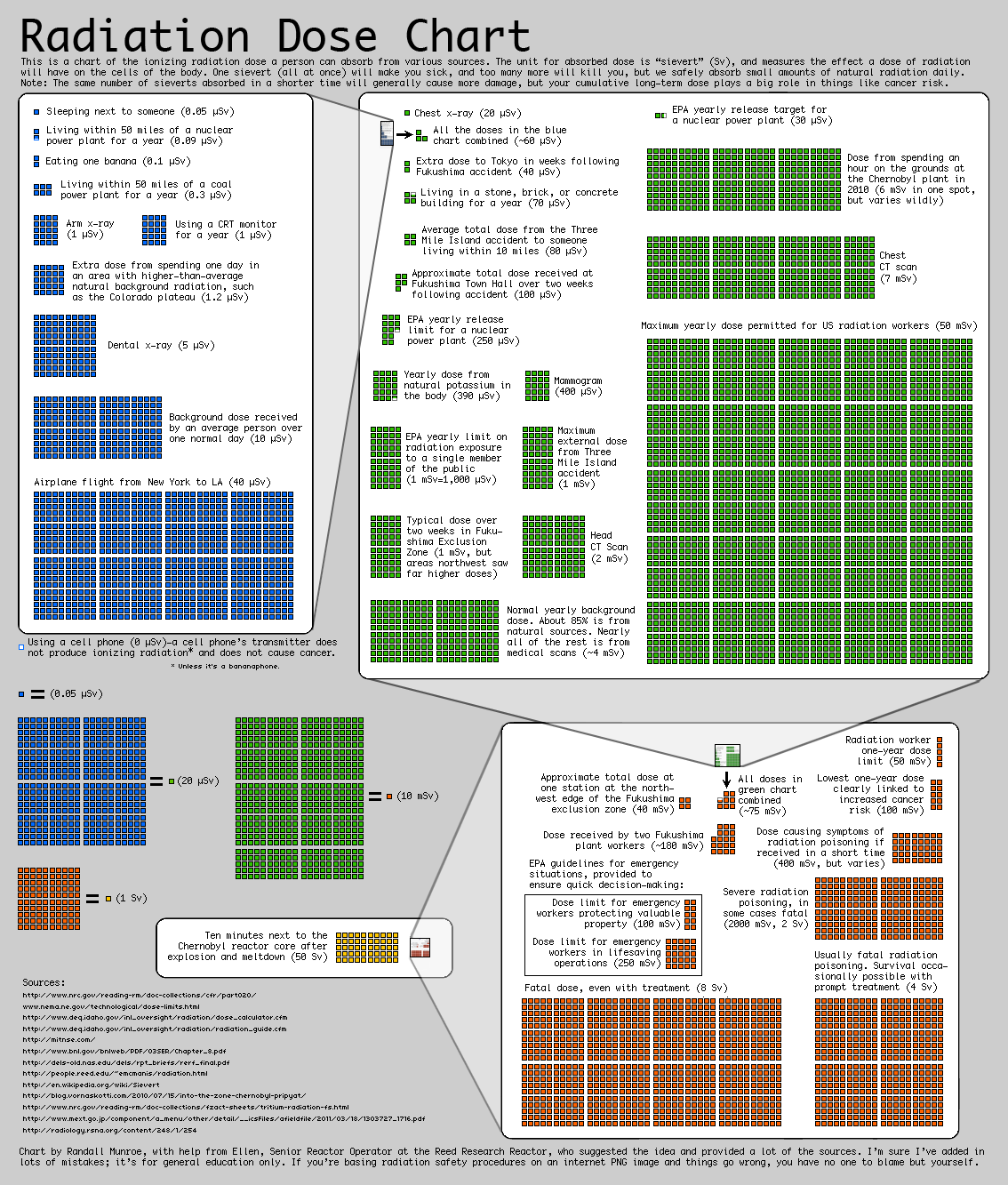
Since I have very little understanding of nuclear exposure levels, I found
this chart to be very informative.
Looking the chart over (and reading about reported radiation levels at the plant) it seems clear that over the past 10 days (emergency) workers at the Fukushima plant have been exposed to levels of radiation above what is considered safe over an entire year. With reported readings at the plant sometimes exceeding 3.6milliSv/hr (which is background/normal exposure for a year!) many workers are nearing if not exceeding doses that are clearly linked to increased cancer risk (~100milliSv/yr). While the readings occasionally jump to high values and then fall back down, if a worker were exposed continuously to the high level of these readings for 100 hours (10 days at 10 hours per day) they would have recieved a cummulative dose associated with radiation sickness.
One can only hope that Japan will soon be able to improve the situation at Fukushima, but we should be prepared for a couple more nasty surprises (and likely several days of delays) before things start to improve measurably.
Japan's disaster cubed
I've been riveted to my TV & computer since Friday, trying to comprehend the devestation of a 9.0 earthquake (upgraded from 8.9), + an 8m tsunami, + a desperate situation when nuclear cooling systems failed at a power plant in Fukushima. Whenever you see such utter devastation and human tradgedy and suffering on a national scale it is truely heartbreaking. I am so so saddened by the loss..
And reminded how precious and unpredictable living on this always changing planet is.
Watching the developing nuclear meltdown in Japan has certainly been a flashing reminder of the dangers posed by so called "safe" nuclear power...I live in Chicago, literally surrounded by about 11 nuke plants. Even when functioning within design limits nuclear plants create tons of really bad stuff (waste) every year. And clearly a 9.0 earthquake exceeded the design and safety limits at Fukushima. We do not yet know how this "incident" will end, although it seems to go from bad to worse.
I believe it has already gotten bad enough to derail the nuclear renaissance many in that industry hoped for. And any pullback there will be a big blow to efforts to fight climate change, since coal is the obvious baseload alternative. That said, in the mid-to-long term this presents opportunities for "true" renewables like wind, solar, and especially fledgling geothermal and wave power which have the power profiles that can support baseload demand without storage.
But even more important than switching our energy ravenous society onto the next "fuel source", I think we need to take a completely different attitude to reducing our power requirements.
We need to embrace RADICAL EFFICIENCY. Creating and designing systems that require 1/3 (or less) as much energy to sustain them. And we can't wait 20, 30 or 40 years to get to a more efficient equilibrium. We need to get there in 10 years. This means we need to be doing the planning today and start implimenting(!) systems 2, 3 or 4 years!